

List of Yamaha E-70 & EX-2 mods
The amount of modifications I'm finding whilst deep-diving the E-70 are staggering so I'm compiling a proper list on this page.
This page will be updated every time I or someone else finds a new mod. If you have any suggestions feel free to contact me.
These mods primarily ignore the preset boards and often disconnect these to allow for full custom control. However: you can apply some mods by replacing resistors with variable ones on the preset boards. Of course, all parameters that the preset boards control, you can as well as they are all analog CV.
- Some of these will not have been tested yet and are purely conceptual. If so the title will be noted in red.
- If there's been some initial progress on a mod, but it still has issues the title will be noted in yellow.
- White titles are mods that are finished and are actively in use.
- The included images can be enlarged by clicking on them.
All these mods are at your own risk! I take no responsibility for an organ on fire :)
External links
Make sure to check out these websites:
- My own deep-dive page with detailed information on the inner workings, also contains a detailed technical document.
- My friend Marc has written a lot about E-70 modifications for a project named Son of GX.
- Jacob Korn also build a Son of GX.
- VERY long organforum thread about all the technical speculations on the E-70 and its mods.
- Good CS-80 circuit diagrams with explanations (for modding reference).
Oscillator mods

Orchestra manual waveform selection
Normally the preset boards determine what waveforms are selected and send signals to the points in the picture, found on the VMS board. Instead add switches that provide direct control.
These would switch between GND and -15V for on/off. You could also switch between the preset and GND for preset/on toggling.
Either way you can select a single waveform or layer up to 3 waveforms and make any combination. Waveforms can be set per keyboard as well.

Orchestra amplitude modulation via waveform generator
The orchestra waveform generators are not using the 'IL' and 'IH' envelope CV inputs. Instead these are tied to GND and -5V for both oscillators. These can be found on the VMS board.
Alternatively the envelope memory IC can have the same thing done to it, to modulate all waveform generators all at once in an easier way. See the Flutes AM mod below.
Instead a custom signal could be fed to these inputs of either one or both of the oscillators. Either a free running LFO or using the (buffered) output of one of the other waveform generators (either of the same oscillator or the second one). Keep in mind you cannot filter this signal as it includes the serial processing of multiple voices.
The envelopes normally go from GND to -5V, with zero amplitude being -2.5V. So it's best to stay between the original GND and -5V to prevent issues.
To keep the waveform DC centered (-2.5V) it's a good idea to apply the normal signal to IH and then an inverted version to IL.
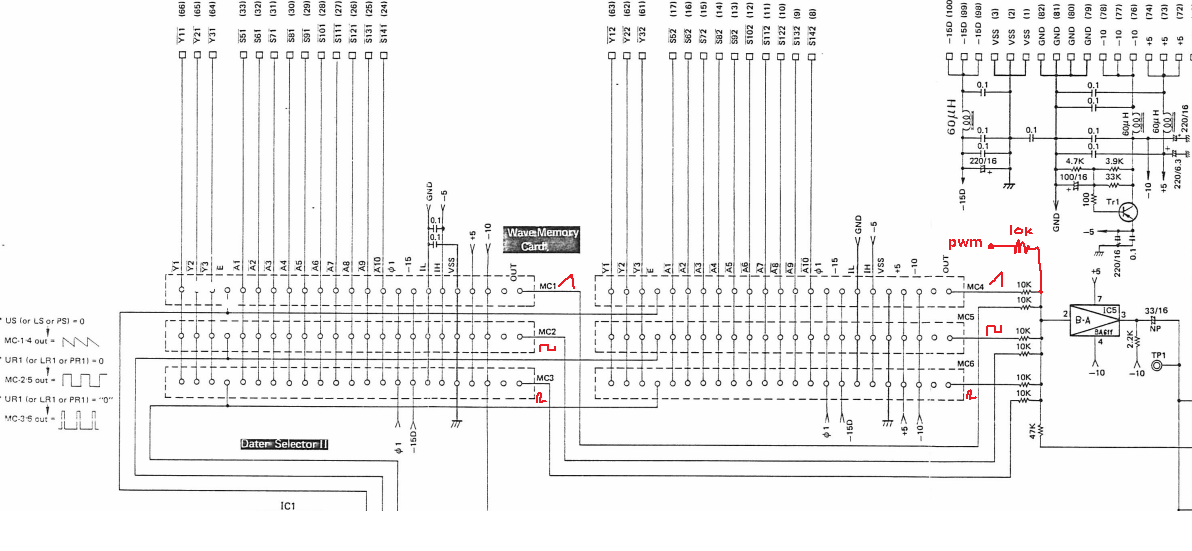
PWM for Orchestra
TODO!
With a fast enough opamp this could be done before the demultiplexing/S&H, thus simplifying the circuitry to a single PWM opamp comparator circuit on the sawtooth waveform card output.
The opamp needs to be fast enough to allow the serial processing at 1MHz to pass through unaffected, so the S&H properly samples the PWM waveform voltages.
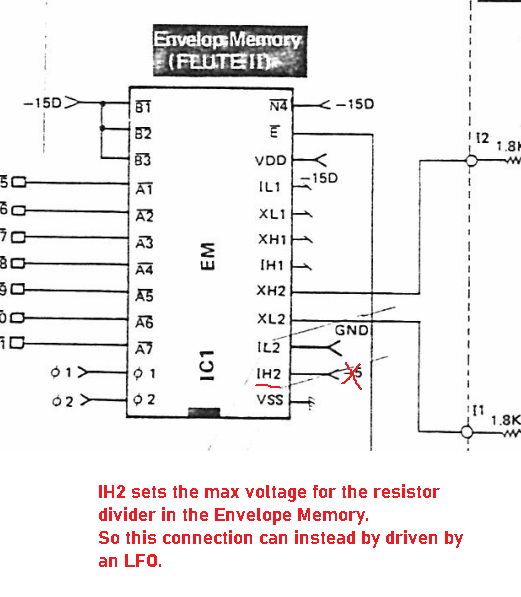
Flutes amplitude modulation via envelope memory
The Flutes waveform generators cannot be amplitude modulated directly via IL & IH.
However the envelope generators use a memory IC that has two similar input, which are also tied to GND and -5V. The -5V can be replaced by an LFO to modulate the envelope output and thus all the waveform generators it outputs to.
What I've done is have an active mixer that mixes the original -5V and outputs from the other oscillator, amplified to 5V peak-to-peak, with a DC center of -2.5V. It being an active mixer is important as a buffer is needed to drive the Envelope Memory which is a resistor divider. A passive mixer would introduce an unwanted offset in this divider.
BEWARE: the service manual seems to have some mistakes, GND and -5V pins may be reversed.

Flutes square wave or stepped wave switch
My only letting the top 2 bits through the sine wave should change into a square wave. This could be done via an 9-bit gate (AND gates or octal buffers) with an enable connection routed to a switch to toggle between the normal sine and the square waves. A0 to A8 would be gated.
Due to the full 16 bits being used, because of the multiple footages, only the lowest footage will be a pure square wave. Higher footages will have an increasing amount of steps.
If all footages need to be pure square waves, then the waveform generator boards themselves need to each have a gate, which requires modifying those boards themselves, though a simple adapter board that sits between the main PCB and the waveform generator PCB would also work.

Flutes secret 6 2/5th footage
There are actually 10 sine waves being generated by the Flutes, though only 9 are accessible on the front panels. The 10th "secret" footage is only used for the Chimes preset, thus is fully functional and could be modded to have a drawbar for your own organ sounds.
Simply take the output from the IF board and route it to a potentiometer of choice. The other footages split off to the custom preset panel, so you could do the same for the new footage. Though you would need to add a new slider or something to the panel...

Flutes second oscillator octave shift switch
It is possible to make the two oscillator setup of the E-70 Flutes more interesting, besides the stock detune setting. The oscillators can be shifted from 1 oct down to 3 oct up, however the setting always applies to both oscillators.
The mod points can be found on the FRW board.
This mod does require the cutting of traces, so that only the second oscillator is affected.
You can either add an octave-down switch to F1, that toggles between the original signal and -15V, or you can add a rotary switch with diodes and a pull-down resistor that toggles through the binary values as noted in the picture, so you can have the full range of octave shifts.
Keep in mind that F1-F3 are used by the arpeggiator, so having the switch active could mess this up. However adding diodes for the arpeggiator as well OR gates its output with that of your switch so both will work at the same time.

Change note temperament
P1 and P2 of the F-ROM are tied to -15V and thus are unused.
From my testing it seems these set the temperament of the notes, with 4 different settings (2 bits). Simply adding switches between -15V and 0V/GND works.
Not very exciting but can be used as a very subtle detune or to add a bit of "analog" variation to the notes.

Attack Pitch direction switch
By forcing V7 high or low the direction of the Attack Pitch effect could be changed between up or down.
The vibrato and attack pitch signals come from the VG chip.
Adding MIDI support
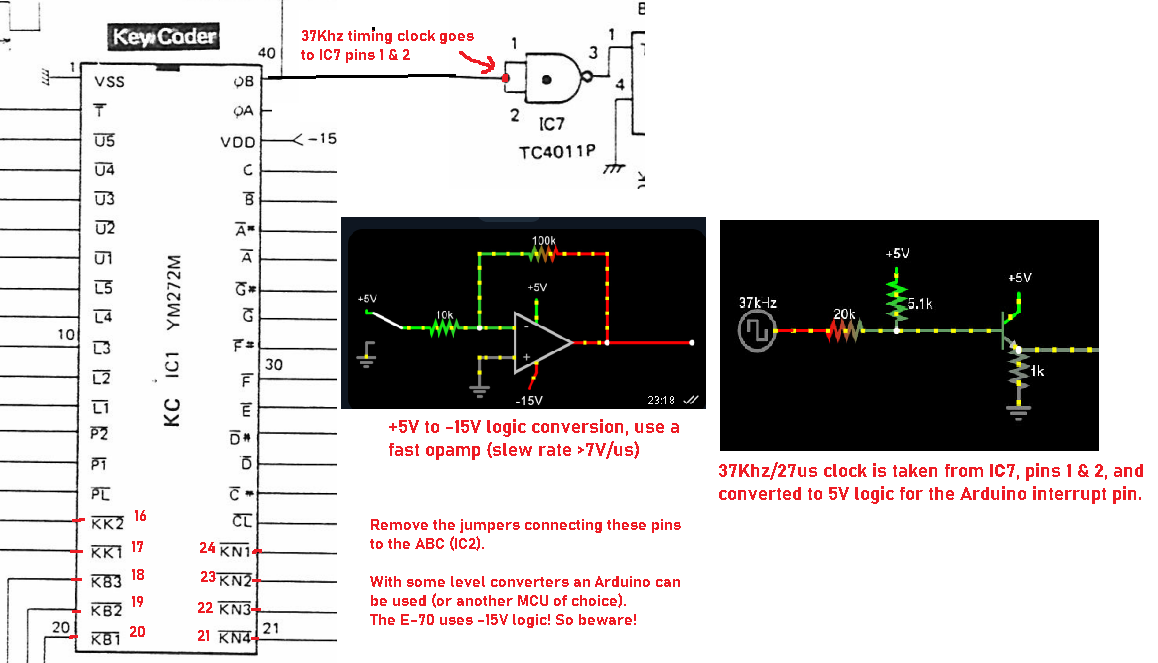
The connections between the Key Coder and the rest of the circuitry can easily be hijacked by removing 9 jumpers (how convenient!) and reconnecting everything to a microcontroller of choice. The timing clock signal can be taken from IC7, pins 1&2, and used as an external interrupt. All this can be found on the KCA board.
The E-70 uses -15V logic! So make sure to use proper level conversion, otherwise you'll blow things up. I've used inverting opamps (with high slew rate, such as TL071 and TL074) to convert the +5V from the Arduino to -15V for the E-70.
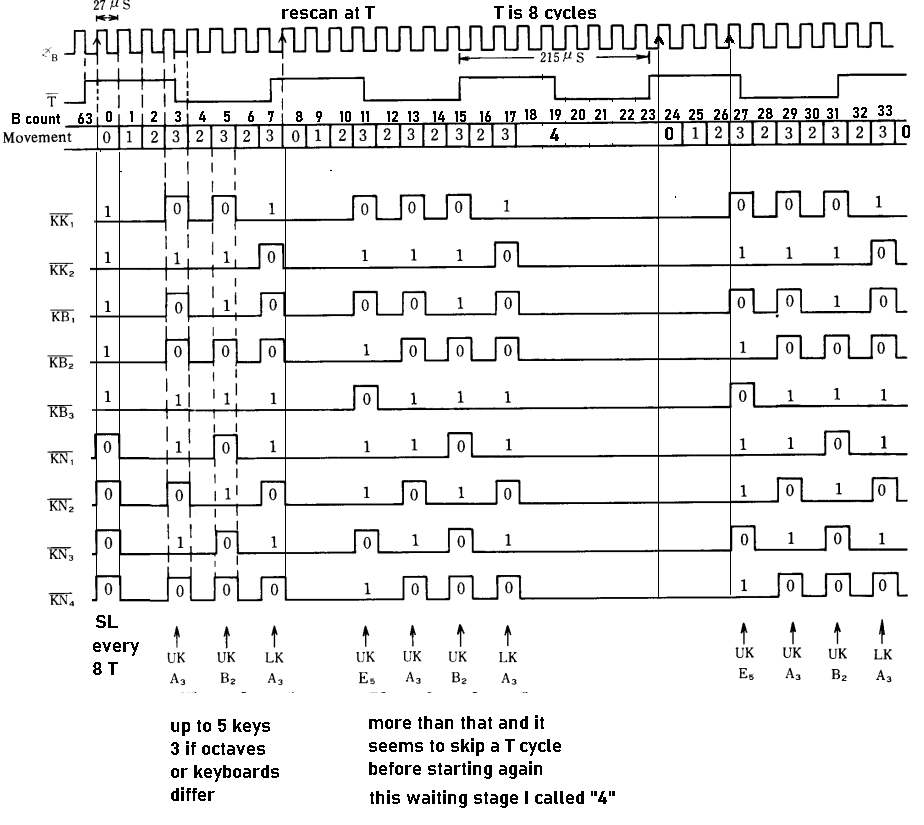
The microcontroller could forward the data generated by the Key Coder, whilst appending new data from MIDI commands. This way you can keep the keyboards fully functional.
I've added a diagram of the KC data, with timing and counters. This will act as a reference guide to the Arduino Uno code I've written: download. This code is only for the MIDI -> key code conversion as my E-70 project has no keyboards.
It should work, but there are still some minor bugs that need fixing, these are noted in the code.
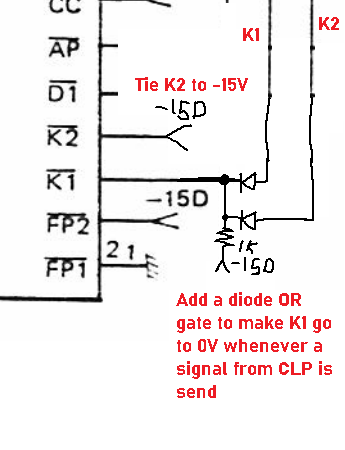
Force Upper Keyboard when Lower is send (Additive Synth)
K1 and K2 could be OR gated via two diodes to K1 with K2 tied to -15V on the Flute boards (AEG and FWM1/2) to make all notes be played on the upper keyboard outputs, this way all 10 footages can be played for the lower keyboard too.
This mod is required for the Additive Synth mod.
TODO:
Analog VCO for orchestra voices: the VCG board circuitry outputs a control voltage per-voice which is used for keyboard tracking for the many VCF. Of course this could also be used to control a VCO etc... Will need to scale the voltage for proper tracking though?
Have separate drawbars for the second oscillator, allowing for more interesting sound shaping in combination with the second envelope mod. Requires the K1/K2 OR gate and repurposing the Lower keyboard & Attack (or Pedal) IF filters to route the 10 footages of the second oscillator through. (required for additive synth mod)
Distributors output all footages for Lower keyboard too and thus could be connected, this may allow Lower keyboard to have the same 10 footages as the Upper. Distributors could also simply be removed and the in/outs tied with jumpers.
Pedal footages could be expanded this way too.
Shifting the second oscillator by semitones, by changing the 4-bit note value the F-ROM receives. This will require digital logic however, due to the serial processing. 4-bit binary adder such as the CD4008 could work? This will only work if the note codes aren't weird though. Will need to look at the guide book some more... Otherwise a small & fast MCU with level converters would also work well enough.
adding new waveforms, by using an EEPROM, RAM or MCU. 16-bit WaveCounter bus can simply be used. DAC output can be passively mixed in, need an extra switch to toggle this new waveform on/off (or a rotary for selecting off/multiple waveforms)
Noise waveform option would be cool, there are various noise sources available. Is super easy to just blend this in for the Orchestra, at the waveform generators main output. There isn't need for demultiplexing as noise is always just pitch-less.
The Vibrato input of F-ROM can be directly controlled to provide coarse detune of up to +/- 100 cents (1 semitone)
VCF mods
TODO:
cutoff, resonance.
cutoff modulation LFO
using the actual multimode/bandpass outputs of both filters and mix them for more complex sound shaping.
Keyboard tracking uses an envelope memory IC, with IL and IH going to trimmers. May allow for adjustment over the range. May or may not be handy.
VCA mods
TODO:
amplitude modulation LFO
anything else?
Envelope mods

Enable repeat envelope mode for Flutes
IC1 envelope generator for the Flutes has the repeat function permanently disabled by having FU3 and FL3 tied to -15V, whereas the Attack envelope generator has these switchable for Attack repeats.
The Flute envelope generator can also have a repeat mode, by replacing the -15V connection with a switch to toggle between -15V and GND for repeat off/on.
TODO:
envelope timing VCO mods for Flute (some are not VCO, but could still be modded or replaced) & Orchestra, envelope level control voltages.
Flute per-footage envelope offsets by shifting IL and IH for individual waveform generators.
unlocking the unused envelope features for the Flutes & Orchestra may be fun. This would also allow the Attack envelope generator to act as a second envelope for the second oscillator, with some rewiring. (required for additive synth mod)
Misc mods
TODO:
analog drums are very moddable allowing for a flexible sound,
custom rhythms, syncing with external rhythm machines, allowing for external gate/trigger signals.
Ring modulator CS style(?), need to find a suitably simple circuit that could be implemented per-voice. If not it'll be paraphonic like the CS-80 has.
Stereo (BBD) chorus would really solidify the CS-80 sound as well. The CS-80 chorus seems pretty standard.
The E-75 has a triple BBD stereo chorus(!), would be cool to put this board into the E-70. Is likely compatible.